
Google’s Old Search Era Is Over – Here’s What 2026 SEO Will Really Look Like
January 30, 2026, 5:30 AM
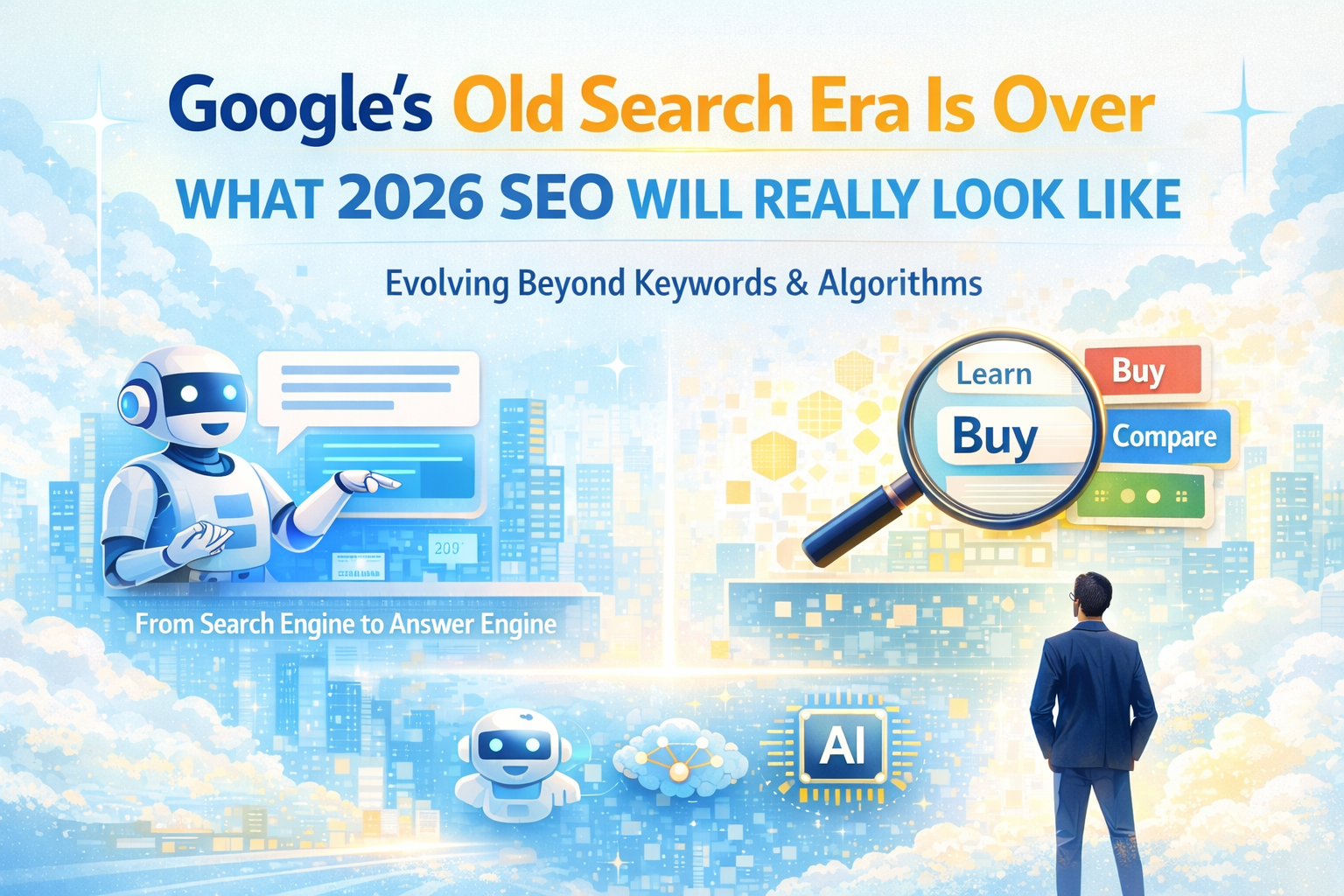
Search has changed—and the old rules no longer apply. In 2026, SEO is no longer about gaming algorithms; it's about creating real value, earning genuine trust, and showing up for the right people at the right moment.
From Keywords to Context: How SEO Thinks in 2026
The old Google playbook is officially dead. Word counts, keyword density, awkward keyword stuffing, and robotic optimization tricks belong to a different internet—one that no longer exists. Search has evolved, and so has Google. What once rewarded mechanical repetition now rewards meaning, relevance, and real value.
Artificial intelligence didn’t just tweak search behavior—it rewired it even for the best digital marketing agency in India. Algorithms no longer scan pages looking for repeated phrases; they interpret intent, context, and credibility. Search engines are learning to think more like humans, not machines. That means SEO tactics
2026, isn’t about ranking for words—it’s about answering questions, solving problems, and becoming a trusted digital presence.
So what works exactly? Let's explore in this blog how for businesses, this shift changes everything. Agencies like Consumer Sketch are already ahead of this curve—blending technology, creativity, and data-driven strategies to help brands build visibility that truly lasts. Visibility is no longer owned by whoever plays the algorithm best—it belongs to whoever understands people best.
Rising Concepts That Will Define 2026 Google seo trends
1. Search Generative Experience (SGE): Search Is Becoming an Answer Engine
Google is transforming from a search engine into a decision engine. With Search Generative Experience (SGE), users don’t just get links—they get synthesized answers, summaries, comparisons, and AI-generated responses pulled from multiple trusted sources.
This means ranking alone isn’t the goal anymore. Being understood, cited, and trusted by AI systems is the new currency. Content must now be structured, clear, authoritative, and semantically rich so AI systems can extract meaning—not just index text.
-
Websites that survive this shift will:
-
Provide clear explanations, not vague fluff
-
Use structured data that AI systems can interpret
-
Build entity relationships (brands, services, locations, expertise)
-
Focus on topic authority, not scattered keywords
If your content isn’t understandable to machines that think in concepts, it won’t matter how good your keywords are.
2. User Intent Is the New Ranking Factor
Search intent has replaced search terms, and it’s beyond Google SEO news. Google no longer asks, “What words are on this page?”
It asks, “What problem does this page solve?”
Trends in SEO is shifting from keyword targeting to intent modeling:
-
Informational intent → learning
-
Navigational intent → finding
-
Transactional intent → buying
-
Comparative intent → choosing
Pages that don’t match intent won’t rank—even if they’re optimized perfectly.
2026 SEO is about designing content around user journeys, not keyword lists:
-
Awareness content
-
Consideration content
-
Decision-stage content
-
Trust-building content
Search is becoming behavioral, not textual.
3. Authority Is No Longer Claimed — It’s Proven
Authority used to mean backlinks. In 2026, authority means recognition across ecosystems, even for SEO search engine.
Google doesn’t just analyze links anymore—it reads brand mentions, citations, platform presence, structured data, and cross-platform signals.
True authority now looks like:
-
Consistent brand presence across platforms
-
Verified expertise in specific domains
-
Thought leadership content
-
Mentions across trusted sources
-
Recognition in AI-generated answers
-
Entity-based validation through structured data.
This is entity-based SEO:
Not “ranking pages,” but building digital identities that algorithms recognize as real, credible, and reliable.
4. Multi-Platform Visibility Is Non-Negotiable
Your website is no longer your only SEO asset. Google now pulls signals from the entire internet ecosystem.
2026 SEO requires diversification:
-
YouTube → search + discovery + AI training data
-
TikTok → behavioral signals + trend authority
-
Reddit → trust-based community data
-
LinkedIn → professional authority + entity trust
-
Podcasts → voice search data
-
Forums → conversational data
-
PDFs, research docs, whitepapers → LLM training material
If your brand only exists on your website, it’s invisible to modern AI ecosystems.
SEO is becoming platform-agnostic visibility engineering.
The New SEO Model: Entity-Based & Conversational Search
1. Entity-Based SEO
Google no longer sees websites as pages—it sees them as entities such as Brands, People, Services, Products, Locations, Industries, and Expertise areas.
Entity-based SEO builds structured identity:
Which highlights who you are, what you do, who you serve,
where you operate, and more importantly, why you’re credible.
This is why schema markup becomes foundational—not optional.
2. Conversational SEO
Search is becoming spoken, not typed:
-
Voice assistants
-
AI chat interfaces
-
Conversational search
-
Prompt-based discovery
Content now must sound natural, human, and fluid—because AI learns language patterns from real conversations.
If your content reads like an SEO copy, it won’t survive AI indexing. And the best digital marketing agency in India are evolving to that.
Emerging Tactics for 2026 SEO
Press Releases as AI Visibility Tools
Press releases are no longer PR—they’re LLM ingestion assets.
AI models learn from structured, authoritative publications. Strategic press distribution builds:
-
Brand entity recognition
-
Trust signals
-
AI training exposure
-
Knowledge graph presence
-
JSON Schema as AI Language
-
Schema is no longer just for snippets—it’s for AI comprehension.
-
Structured data tells machines how to interpret meaning, relationships, and relevance.
-
PDFs as AI Training Content
Whitepapers, guides, reports, and PDFs are now being indexed by LLMs.
They act as long-form knowledge sources for AI systems—not just users.
What This Means for Businesses
SEO is no longer:
-
Ranking pages
-
Chasing keywords
-
Gaming algorithms
-
Optimizing density
-
Building random backlinks
SEO is now:
-
Digital trust architecture
-
Brand authority engineering
-
Entity recognition systems
-
Multi-platform visibility strategy
-
AI discoverability frameworks
-
Intent-driven content ecosystems
-
Search has become semantic, behavioral, conversational, and predictive.
The 2026 SEO Reality
The future belongs to brands that understand one truth:
-
SEO is no longer a marketing tactic — it’s a digital identity system.
-
Businesses that win search will be the ones that:
-
Build recognizable digital entities
-
Own topical authority
-
Control their narrative across platforms
-
Structure data for AI comprehension
-
Design content for humans first, machines second
-
Think ecosystems, not websites
Final Thought
Google’s old search era didn’t fade away — it collapsed.
What replaced it isn’t SEO as we knew it — it’s something bigger, deeper, and more intelligent.
2026 SEO is not about being found.
It’s about being understood, trusted, and chosen — by humans and machines.
And the brands and best seo companies in India that adapt now won’t just rank in the future —they’ll define it.
FAQs
Is keyword optimization still important in 2026 SEO?
Yes, but only when it supports user intent and natural language, not keyword stuffing.
What is Google’s Search Generative Experience (SGE)?
SGE uses AI to generate direct, contextual answers instead of showing only traditional links.
Why does authority matter more than backlinks now?
Because search engines prioritize trust, expertise, and brand credibility over raw link counts.
Does SEO now extend beyond Google search results?
Absolutely, visibility across platforms like YouTube, Reddit, TikTok, and LinkedIn is now essential.
How can businesses prepare for AI-driven search?
By creating intent-focused content, using structured data, and building a strong multi-platform presence.
Recognized for Excellence