

The Rise of Mojo: Is It the Future of AI Programming?
July 24, 2026, 5:30 AM

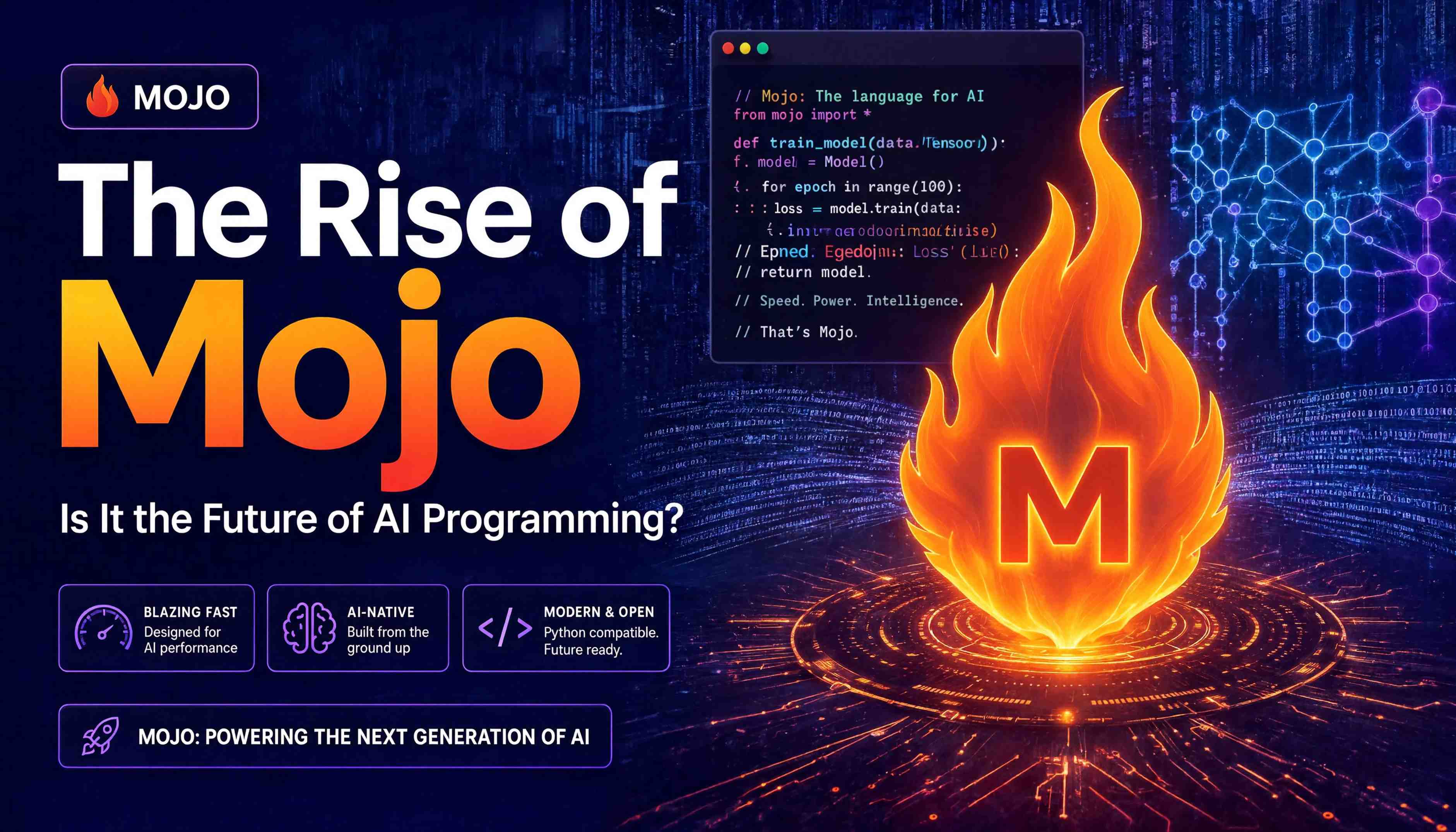
The tools that boost AI are advancing much faster than AI. For years, AI development efforts have leveraged Python. Yet as models grow ever larger and workloads more demanding, its performance limits are becoming harder to ignore. The Mojo programming language is designed to meet those requirements. Mojo combines the easy-to-use syntax of programming languages such as Python with the speed of languages such as C++ and Rust, which are used in machine learning and AI. This article explains what Mojo is and why it is important. Does it belong in your dev stack?
What Is the Mojo Programming Language?
The 2023 Launch of the Mojo language was part of a major effort to revamp the AI infrastructure. AI team found themselves limited to pick one thing from Python’s simplicity or lower-level languages' performance optimization. Mojo aimed to eliminate this trade-off. By 2026, Mojo is expected to hit 1.0. It’s currently in beta, and Modular hopes to achieve a stable version later this year.
Who Created Mojo?
Modular Mojo originates from Modular, an AI infrastructure company established by Chris Lattner and Tim Davis in 2022. Renowned amongst programmers, Lattner is the man behind the LLVM compiler infrastructure and Swift programming language, while Davis formerly led the machine learning infrastructure at Google. With that in mind, it was the genesis of Mojo: a language that was created explicitly for compiler-level performance. Recently, Mojo's momentum has garnered the attention of the chip industry too. In June 2026, Qualcomm announced its intention to acquire Modular, an all-stock deal worth about $39 million, to integrate the Mojo A.I. chip and its MAX inference engine into Qualcomm's stack. The transaction is likely to finalize during the latter half of 2026.
Mojo development stemmed from an intention to solve a specific AI problem. Python is the most popular language for machine learning; it was never designed for the heavy computing required for AI today. Often, developers had to write performance-critical code in C++/CUDA and wrap it for Python, resulting in added complexity and delayed development cycles. Mojo eliminates the additional step.
How Mojo Combines Python Simplicity with System-Level Performance
As an AI programming language, Mojo uses Python-like syntax so existing developers can adapt quickly. Underneath that familiar surface, it compiles to machine code using MLIR (Multi-Level Intermediate Representation), giving it performance that can rival traditional systems languages. The result is a language that reads like Python but runs like a compiled, low-level program.
Why Mojo Is Gaining Attention in AI Development
The Growing Demand for Faster AI Development
AI models are growing more complex, the datasets are getting heavier, and deployment timelines are accelerating. Development teams want tools that can keep up without forcing teams to completely rewrite their existing codebase. This increasing pressure is one of the biggest reasons behind Mojo for AI gaining great traction across the industry.
Performance Challenges with Python
With Python’s simplicity and flexibility comes a certain level of ambiguity and disorder. Being interpreted, Python is noticeably slower than compiled languages. For everyday scripting, this doesn’t matter, but when training large models or running real-time inference, those performance gaps result in higher charges and longer waits. This is where the urgent search begins for a powerful AI programming language that is built for speed.
How Mojo Addresses AI Workloads
Mojo addresses this issue from the language’s side instead of some external workaround. With C, developers directly access memory and hardware resources, yet the code stays understandable. Engineers do not need to leave a single codebase, allowing them to stay in the area of C++. When you run jobs at scale, every millisecond counts. This is particularly important for teams running large-scale training jobs, real-time inference pipelines, or doing edge deployments.
Benefits for Machine Learning Engineers
Mojo is a practical compromise for ML engineers. You won’t have to coordinate several different machine learning programming languages for a single project when you use ML as a programming language. Engineers can prototype in a Python-like syntax, which they can optimize for production without switching tools. This, combined with strong Mojo performance benchmarks, makes it a good option for teams wanting to reduce both development time and compute costs.

Key Features of the Mojo Programming Language
#1. Python-Compatible Syntax
One of Mojo's biggest selling points is its Mojo syntax. It's designed to feel immediately familiar to Python developers, using similar structures, indentation rules, and function definitions. This lowers the learning curve considerably and means teams don't need to retrain developers from scratch to start using it.
#2. High Performance Through Compilation
Unlike Python, which is interpreted line by line, Mojo is compiled using the Mojo compiler, built on MLIR technology. This compilation step allows Mojo code to be optimized for the specific hardware it runs on, resulting in execution speeds that can be dramatically faster than standard Python for compute-intensive tasks.
#3. Memory Management and Ownership Model
Mojo introduces an ownership-based memory model similar in spirit to Rust. This gives developers fine-grained control over how memory is allocated and released, reducing the risk of memory leaks and improving overall program stability, all without the manual overhead required in languages like C++.
#4. Parallel Processing Support
Modern AI workloads rely heavily on parallel computation. Mojo includes built-in support for parallelization, letting developers distribute workloads across multiple CPU cores more efficiently than Python's traditional threading model allows.
#5. Hardware Acceleration
As a high-performance programming language, Mojo is designed with hardware acceleration in mind. It can take advantage of GPUs and specialized AI accelerators, making it well suited for training and running large-scale AI models where hardware efficiency directly impacts cost.
#6. Easy Integration with Existing Python Libraries
Mojo allows developers to retain their existing Python ecosystem. Compatibility with many widely used Python libraries allows teams to adopt Mojo in performance-critical sections of a project while continuing to use NumPy, PyTorch and similar tools elsewhere.
Mojo vs Python: What's the Difference?
#1. Performance Comparison
The most notable difference in the Mojo vs Python discussion is raw speed. Because Mojo compiles directly to machine code, it can execute compute-heavy tasks significantly faster than interpreted Python, particularly in loops, numerical operations, and large-scale data processing.
#2. Syntax Comparison
Syntax-wise, the two languages look nearly identical at a glance. Mojo was intentionally designed to mirror Python's structure, so developers transitioning between the two won't face a steep syntax learning curve.
#3. Memory Management
Using automatic garbage collection makes Python easy to use, but less predictable in performance-critical applications. Mojo’s ownership model gives developers explicit control over memory. The model trades some simplicity for much better performance and reliability in high-demand systems.
#4. AI and Machine Learning Capabilities
Although Python is currently the industry standard and boasts a huge ecosystem of libraries, Mojo is trying to position itself as a Python alternative for AI for performance-critical components. Mojo typically interfaces with Python instead of replacing it, and it manages those high-speed sections of a pipeline.
#5. Learning Curve
The simplicity of Python makes it one of the easiest languages to learn. Mojo has also inherited much of Python’s easy-going character. Those who are developers of Python would have no trouble picking up Mojo's core syntax but would need more time to master memory management and systems-level features.
Real-World Use Cases of Mojo
AI Model Training
Training large AI models requires enormous computational resources. Mojo's compiled performance can reduce training times and lower infrastructure costs, making it attractive for teams working with large language models and deep learning systems.
Scientific Computing
Mojo is also suitable for scientific computing applications that require heavy number crunching, simulations, and data modelling. For a long time, Python’s performance issues have pushed researchers in domains like this to languages like Fortran or C++.
Robotics and Edge AI
In resource-constrained hardware environments, implementation efficiency is critical for robotics and edge AI applications. Mojo's capability to efficiently optimize code for various hardware makes it an ideal candidate for constrained environments.
Data Processing Pipelines
Contemporary artificial intelligence systems rely on processing terabytes of information. Mojo can significantly accelerate data preprocessing and transformation tasks that would typically be bottlenecks in a Python-only pipeline, making it a useful addition to the wider set of AI development tools of late.
High-Performance Computing
Mojo is employed as a systems programming language in high-performance computing systems requiring modern language flexibility with performance equivalent to existing systems languages.
Conclusion
Mojo is a significant move in the area of AI development, marrying the familiar syntax of Python with the kind of performance compute-heavy workloads demand. Machine learning engineers confront practical challenges on daily basis, for example, model training takes time and data pipelines fail frequently. Python is still the go-to programming language for general AI with a huge ecosystem and community backing, but when performance is the goal, Mojo is emerging as the language of choice. The fact that Qualcomm is acquiring Modular suggests that the chip industry sees Mojo's approach having real staying power. With the constant development of AI workloads, Mojo’s importance will also keep increasing in the ecosystem. Developers and teams interested in future-proofing their AI stack should begin to inch towards supporting Mojo.
Frequently Asked Questions (FAQs)
1. Is Mojo better than Python for AI?
Mojo isn't necessarily "better" than Python, but it outperforms Python in compute-heavy AI tasks. Most teams use both, relying on Python's ecosystem and Mojo's speed for performance-critical components.
2. Who developed the Mojo programming language?
Mojo was developed by Modular, a company founded by Chris Lattner, creator of LLVM and Swift, alongside Tim Davis, with the goal of unifying AI development under one high-performance language.
3. Can Mojo run Python code?
Yes, Mojo is designed to be a superset of Python, meaning it can run existing Python code while also supporting Mojo-specific features for improved performance.
4. Is Mojo open source?
Partly. The Mojo standard library has been open source since 2024, but the compiler itself is still closed source. Modular has committed to open-sourcing the full compiler in Fall 2026.
5. Should beginners learn Mojo?
Beginners are usually better off starting with Python, given its larger community and resources. However, those already comfortable with Python may find Mojo a natural next step for performance-focused work.
6. What are the main advantages of Mojo?
Mojo's main advantages include Python-like syntax, compiled performance, strong memory management, hardware acceleration, and seamless integration with existing Python libraries.
7. What industries can benefit from Mojo?
Industries relying on AI, robotics, scientific research, and high-performance computing stand to benefit most, particularly where processing speed and computational efficiency directly affect outcomes and costs.
Recognized for Excellence