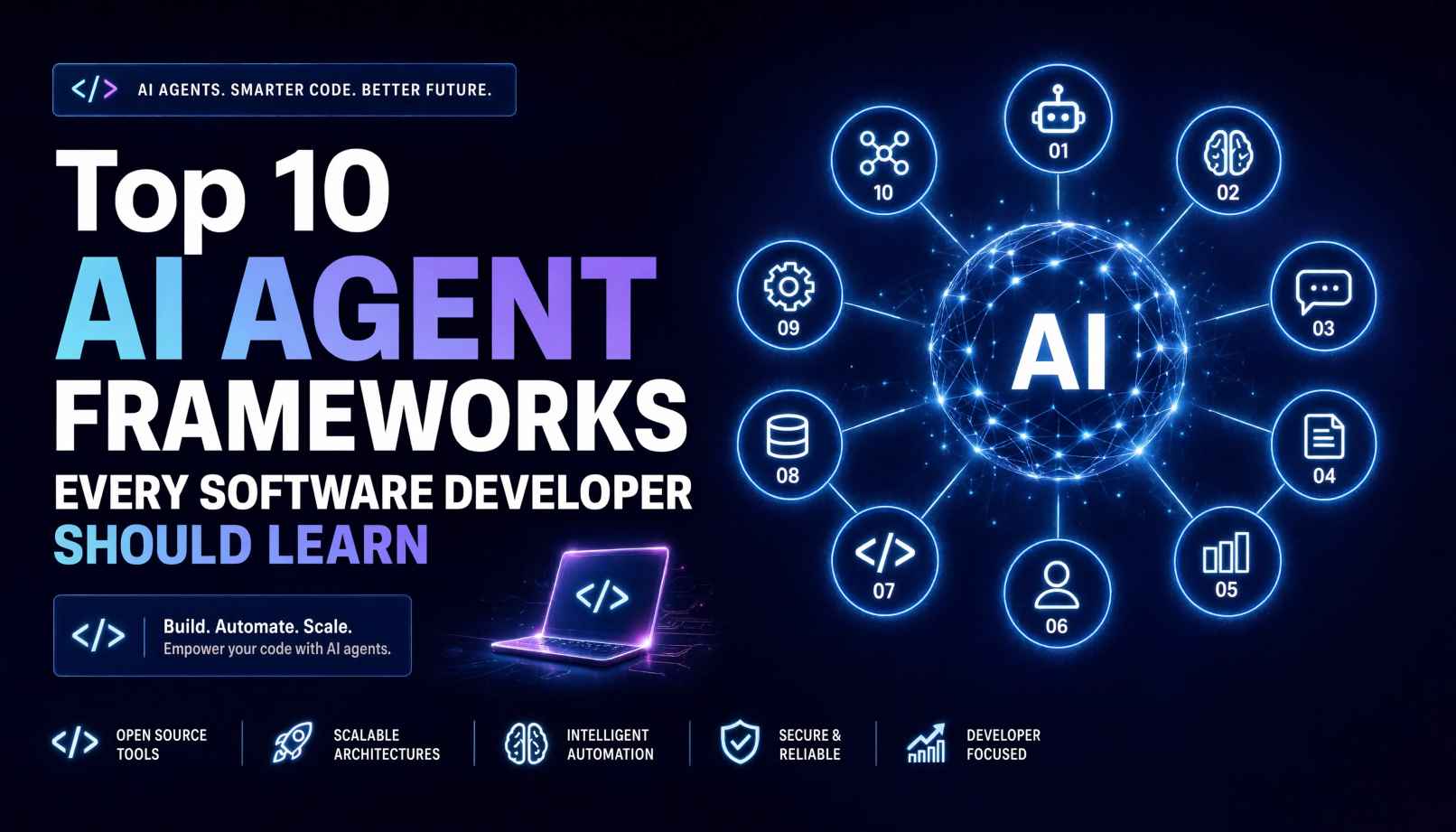
Top 10 AI Agent Frameworks Every Software Developer Should Learn
September 23, 2026, 5:30 AM
In 2026, the field of AI agent frameworks is crowded, and developers' comparison of these agents are quite complex. Most who compare multiple agentic AI frameworks make one mistake: rank by popularity - and stop there. The more relevant question is something at a level deeper. This field churns fast. AutoGen and Semantic Kernel, two of the most recommended names, have already merged into a single successor and shifted to maintenance mode. The frameworks are temporary.
The primitives inside them, reasoning loops, tool calling, state persistence, orchestration, and observability, are permanent. Developers who treat frameworks as vehicles for learning those primitives stay valuable through every cycle of change. That idea shapes everything below.
What Are AI Agent Frameworks?
AI agent is software that takes input of a goal, reasoning on it using a large language model to select actions, invoke external tools and to complete multiple-step tasks with little supervision. This requires memory across conversations, structured tool integration, a persistent state (like a workflow), error handling and coordination between agents working on the same problem - that is what LLM agent frameworks provide.
From an engineering standpoint, building all of that out from first principles is feasible but practically pointless. Teams that try that - only end up rebuilding the same pieces under time pressure, and in general with less reliability than what the open-source community has already gotten. Mature AI frameworks absorb that complexity so effort flows into what the agent actually does.
An agent that works correctly on local tests may choose an incorrect tool once the real traffic lands, lose context hundreds of tokens into conversation or chit-chats itself to a 3x token bill in a loop never seen during development. Great frameworks earn their keep by preventing those failures, and making them quick to diagnose when they happen anyway.
The Top 10 AI Agent Frameworks in 2026
1. LangChain
LangChain continues to be the most popular open-source framework for LLM applications, with roughly 134k GitHub stars and over 1,000 integrated components - including integrations with vector databases, document loaders, and external APIs. Its defining strength is provider abstraction. Switching between OpenAI, Anthropic, Gemini, and Bedrock usually means changing one line of code, which shields projects from vendor lock-in at a time when model leadership changes quarterly.
Why learn it: LangChain wrote the shared vocabulary of agent development. Chains, tools, retrievers, and memory appear in some form across every other framework here, making it the highest-leverage starting point in the field.
2. LangGraph
LangGraph, from the same team, operates closer to the metal. It orchestrates stateful, cyclic multi-agent systems, the architectures that need explicit loops, durable state, and human-in-the-loop checkpoints at defined moments. Where LangChain optimizes for speed of assembly, LangGraph optimizes for precision of control.
Why learn it: Graph-based orchestration has become the industry's dominant mental model for complex agents. Fluency with nodes, edges, and state transitions prepares you for most serious production architectures, whatever tool a team eventually chooses.
3. CrewAI
CrewAI organizes agents the way a manager organizes a team. Each agent receives a persona, a goal, and a set of tools, then collaborates within a crew toward a larger objective. With around 49k GitHub stars, it has become the standard for workflows that break naturally into specialist roles: research pipelines, content production, data triage. It runs local models through Ollama and supports the Model Context Protocol across multiple transports.
Why learn it: The role-based abstraction is the most intuitive in the ecosystem. Developers consistently reach a working multi-agent prototype faster with CrewAI than with anything comparable, which makes it an efficient confidence-builder before moving into deeper agentic AI frameworks.
4. Microsoft Agent Framework
Microsoft Agent Framework combines AutoGen and Semantic Kernel into one orchestrated SDK, available in 1.0 GA April 2026 with Python and .NET runtimes shipping simultaneously. It merges conversational multi-agent patterns with enterprise concepts such as session-based state, middleware, OpenTelemetry compatible telemetry and type safety. Beyond Azure OpenAI, support for models spans Anthropic, Bedrock, Gemini and Ollama, plus integration with Azure AI Foundry provides guard rails to ensure task adherence along with PII protection and prompt injection defence.
Why learn it: Enterprise adoption gathers around Microsoft's tooling decisions. For developers whose work touches .NET, Azure, or large-organization delivery, this is where corporate agent development is consolidating, and its first-class C# runtime stands alone for teams outside Python's orbit.
5. OpenAI Agents SDK
The OpenAI Agents SDK goes deliberately minimal. In place of sweeping abstractions, it offers a small set of clean primitives for handoffs, tool calling, and delegation, with built-in tracing that keeps execution visible during development. MCP support connects agents to external systems, and LiteLLM compatibility routes to non-OpenAI models when needed.
Why learn it: Low abstraction produces high understanding. The SDK hides so little that you watch exactly how an agent selects tools, delegates work, and moves through a task. That visibility builds foundational intuition heavier frameworks can obscure, and it transfers straight into debugging work everywhere else.
6. Google ADK
Google's own Agent Development Kit, with built-in session management, a browser-based debugging interface, and a CLI that exposes agents as services with zero server boilerplate. Deploying targets; Cloud Run, GKE and Vertex AI Agent EngineDeep hooks into IAM, Pub/Sub & BigQuery.
Why learn it: Beyond its obvious value to GCP teams, ADK offers first-class support for both MCP and the Agent2Agent protocol. Protocol literacy is fast becoming its own professional skill, because the next phase of this field involves agents from different vendors talking to each other, and ADK is one of the best places to learn how that conversation works.
7. LlamaIndex Workflows
LlamaIndex Workflows models agent execution as a graph of typed event handlers, each step emitting and receiving events in plain Python. It works quite well to serve document-centric, data-intensive pipelines with a wider view of the LlamaIndex ecosystem: document loading, retrieval tooling and LlamaParse for commercial-grade OCR. Workflows are cleanly embeddable into scripts, notebooks and FastAPI services.
Why learn it: A large share of enterprise agent demand involves documents: contracts, invoices, compliance reports, knowledge bases. This framework teaches event-driven orchestration in exactly the context where organizations spend real money, which makes the skill commercially relevant from your first project.
8. Mastra
Mastra is a TypeScript-first framework from the team behind Gatsby, bundling workflow orchestration, persistent memory through its Memory Gateway, observability, and a dedicated Studio environment into one package. Native integration with React, Next.js, and the Vercel AI SDK lets frontend teams wire agents into applications without custom middleware.
Why learn it: JavaScript developers have long made do with ports of Python-first libraries whose conventions fit the language awkwardly. Mastra was designed for TypeScript from the ground up. For the enormous population of web developers, it removes the language barrier between existing skills and production agent work.
9. Pydantic AI
Pydantic AI comes from the team behind Pydantic, the validation library already living inside most Python LLM agent frameworks. Its core contribution is type-safe agent development: agents return validated, structured data models in place of free-form text, which eliminates an entire category of parsing failures before they ever reach production.
Why learn it: Structured, validated output is where reliable agent engineering is heading. Constraining and verifying what a model returns is a discipline more than a feature, and developers who internalize it write steadier systems in every framework they touch afterward.
10. Hugging Face smolagents
smolagents takes minimalism seriously. Its agents write and execute Python code to accomplish tasks, replacing structured JSON tool calls entirely, and the core logic fits in roughly a thousand readable lines. It connects to the full Hugging Face hub, open-source and locally hosted models included.
Why learn it: A framework small enough to read completely in one sitting demystifies everything the larger ones do. For developers who want to understand agent architecture at the source level rather than through documentation, this is the single most educational codebase in the ecosystem.
How to Choose Where to Start
A sequence that serves most developers well:
● Begin with LangChain or CrewAI to absorb core concepts through approachable abstractions.
● Progress to LangGraph or Microsoft Agent Framework once projects demand durable state and complex orchestration.
● Add the OpenAI Agents SDK or smolagents to see what operates beneath the abstractions.
● Pick an ecosystem specialist: Mastra for TypeScript teams, Google ADK for GCP shops, LlamaIndex Workflows for document pipelines, Pydantic AI where type safety leads.
Let stack fit decide, never star counts. A brilliant Python framework serves a .NET enterprise team poorly, and a GCP-optimized runtime loses most of its value outside Google Cloud. Evaluating against your actual production environment beats evaluating against benchmarks every time.
The Skill Beneath the Frameworks
The opening point deserves its full statement, because it is the part of this subject most coverage misses. Every framework above will look different within eighteen months. Some will merge, as AutoGen and Semantic Kernel already have. Some will fade. New names will arrive with polished documentation and rapid star growth. Treating any single framework as a destination guarantees starting over each cycle.
What holds steady are the five primitives every one of these AI frameworks is built around: reasoning loops, tool calling, state persistence, multi-agent orchestration, and observability. Each framework foregrounds a different one. LangGraph teaches state. CrewAI teaches orchestration. Pydantic AI teaches output discipline. smolagents teaches the reasoning loop itself. Learning several, chosen for the primitives they emphasize, delivers a complete engineering education no single tool provides. That education is what survives the churn.
Final Thoughts
In less than three years, AI agent frameworks have moved from research projects to core professional infrastructure; and the people who are investing deliberately at this level right now (focusing on fundamental pieces versus trendy replacements) are building the products and careers that will shape the coming decade of software. The practical advice is obvious: take one of those frameworks from this list, build something small and self-contained using it, and then use the second that stresses different primitives.
At Consumer Sketch, we have spent more than 20 years turning emerging technology into working software, with 5000+ solutions delivered across 100+ industries. Our development teams build AI-powered web and mobile applications on modern agentic AI frameworks, and our dedicated developers integrate intelligent agents into products engineered for real-world performance. For organizations ready to bring AI agent frameworks into their next project, our team brings the depth to build it right from day one.
Frequently Asked Questions (FAQs)
Which AI agent framework is best for beginners?
CrewAI and LangChain offer the gentlest entry points. CrewAI's role-based model maps naturally onto familiar team structures, while LangChain's extensive documentation and community make problems quick to resolve.
Are these frameworks free to use?
Nearly all are open source under MIT or Apache 2.0 licenses. Real costs come from underlying model API usage, so instrument token consumption early in every project.
Do I need Python to work with LLM agent frameworks?
Python dominates, though real alternatives exist. Mastra delivers a complete TypeScript-first experience, and Microsoft Agent Framework ships first-class .NET support alongside its Python runtime.
Can multiple frameworks operate together in one project?
Yes. Framework-agnostic observability platforms trace agents across different stacks, and protocols like MCP and A2A are turning cross-framework interoperability into standard practice.
How long does it take to learn an AI agent framework?
A working prototype takes a focused weekend with CrewAI or the OpenAI Agents SDK. Production readiness, covering state management, error handling, and evaluation, typically takes a few months of sustained building.
Recognized for Excellence